
The Founder is the First Asset
The Founder is the First Asset
Jan 22, 2026
Before You Build Anything, You Build Yourself
Every entrepreneur repeats the same line — “you have to work on yourself first.” Most people treat it like a cliché, but it survives for one reason: it’s the truth.
Everything you build has the potential to break.
A business can collapse.
A system can fail.
A strategy can age out.
A market can turn.
A partnership can fall apart.
But the one thing that cannot afford to break is you.
Before you build anything external, you must build the internal architecture that can withstand pressure, uncertainty, and the inevitable moments when the world tests your conviction. You prepare yourself not to be broken when the break comes — because it always comes.
This is the core doctrine of the Digital Asset Entrepreneur:
every digital asset, every system, every venture begins with the founder’s identity.
Traditional thinking says the business is the asset.
Sovereign thinking says the founder is the asset.
Businesses rise and fall.
Markets shift.
Technologies evolve.
But a founder with identity, discipline, and proof-of-work becomes a renewable source of value — capable of building again, pivoting again, and rising again.
Foundations are where authorship begins.
Foundations are where survival mode ends.
Foundations are where you become investable through identity, not circumstances.
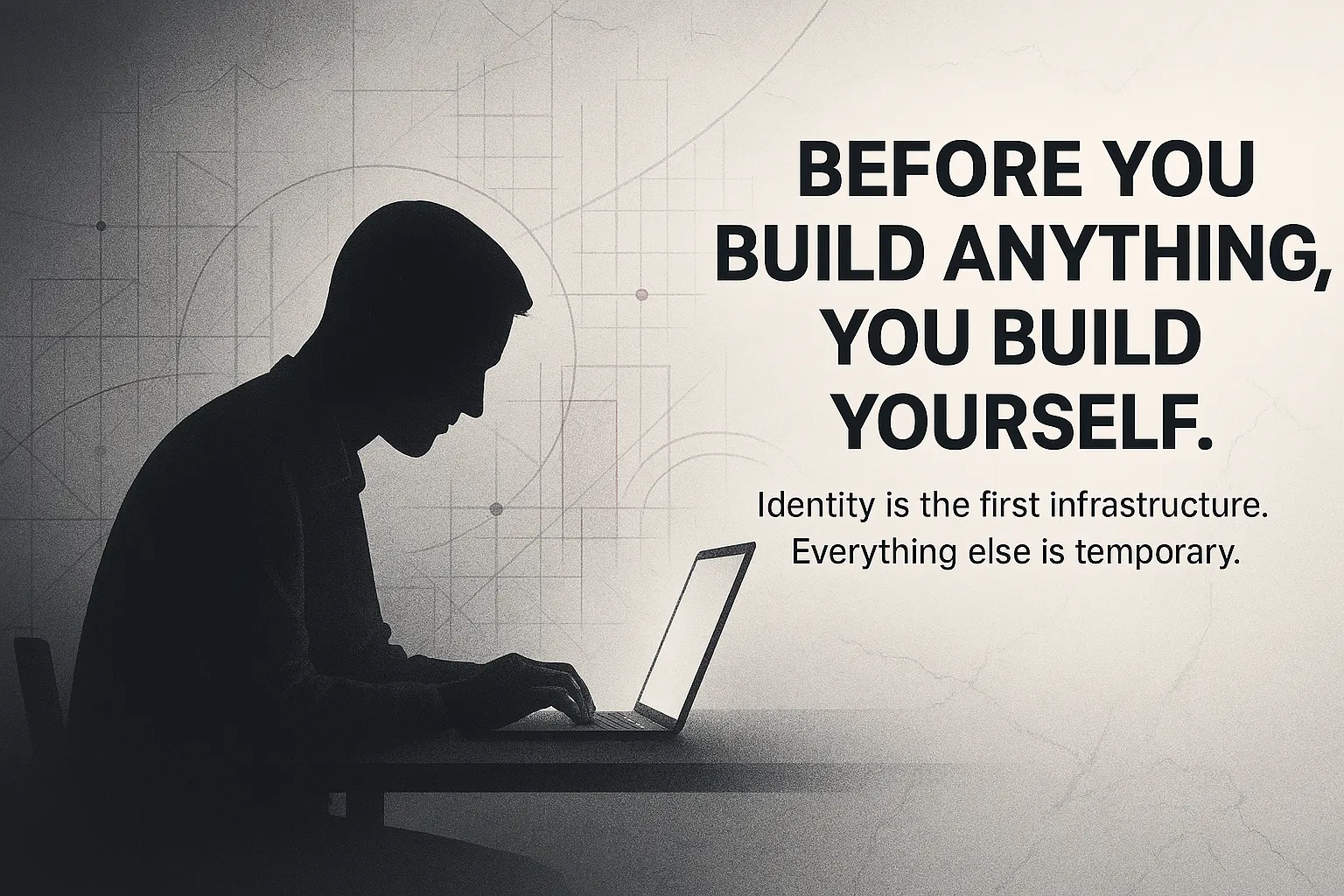
Why Identity Precedes Infrastructure
Entrepreneurs love starting with the visible pieces — the website, the logo, the product, the strategy. It feels productive. It feels real. But infrastructure built on an unstable identity becomes a liability.
Identity always precedes infrastructure because infrastructure amplifies whatever identity built it.
If the founder is inconsistent, the system will be inconsistent.
If the founder is unclear, the strategy will be unclear.
If the founder is reactive, the business will always operate in reaction.
If the founder is shaped by survival mode, every decision will be filtered through fear.
This is why so many ventures collapse before they ever become assets — the infrastructure was fine, but the identity behind it wasn’t ready to carry the weight.
Identity determines:
- how you respond under pressure
- how you navigate uncertainty
- how you make decisions when the path isn’t obvious how you show up when no one is watching
- how you rebuild when something breaks
A strong founder's identity creates stability long before the business becomes stable. It ensures that when the inevitable break happens, you don’t break with it.
Digital Asset Entrepreneurs don’t start with tools or tactics.
They start with the builder.
Infrastructure can be replaced.
Identity must be built.
Proof of Work as the First Currency
Before a founder earns revenue, trust, or investment, they earn something more fundamental: proof of work. It is the earliest form of credibility a founder can produce — the first currency the world recognizes.
Proof of work is the visible, verifiable trail of what you’ve built.
Not what you plan to build.
Not what you talk about building.
What you have already produced — in public, with your name attached.
In the digital age, proof of work leaves a permanent footprint.
And that footprint becomes your first investable asset.
Social media posts are signals, but they are not the substance.
The true proof is in the raw, built assets:
- doctrine pages
- frameworks
- websites
- funnels
- blogs
- newsletters
- brand kits
- curriculum
- public ledgers digital products
- long-form thinking
These artifacts cannot be faked. They require discipline, clarity, and consistency — the traits investors and audiences trust more than early revenue.
A founder with a deep digital footprint becomes investable before the business becomes profitable because the world can see:
- how they think
- how they build
- how they execute
- how they evolve
This is the philosophy behind your Proof-of-Work ledger — a public record of identity in motion.
Revenue is a lagging indicator.
Proof-of-work is the leading one.
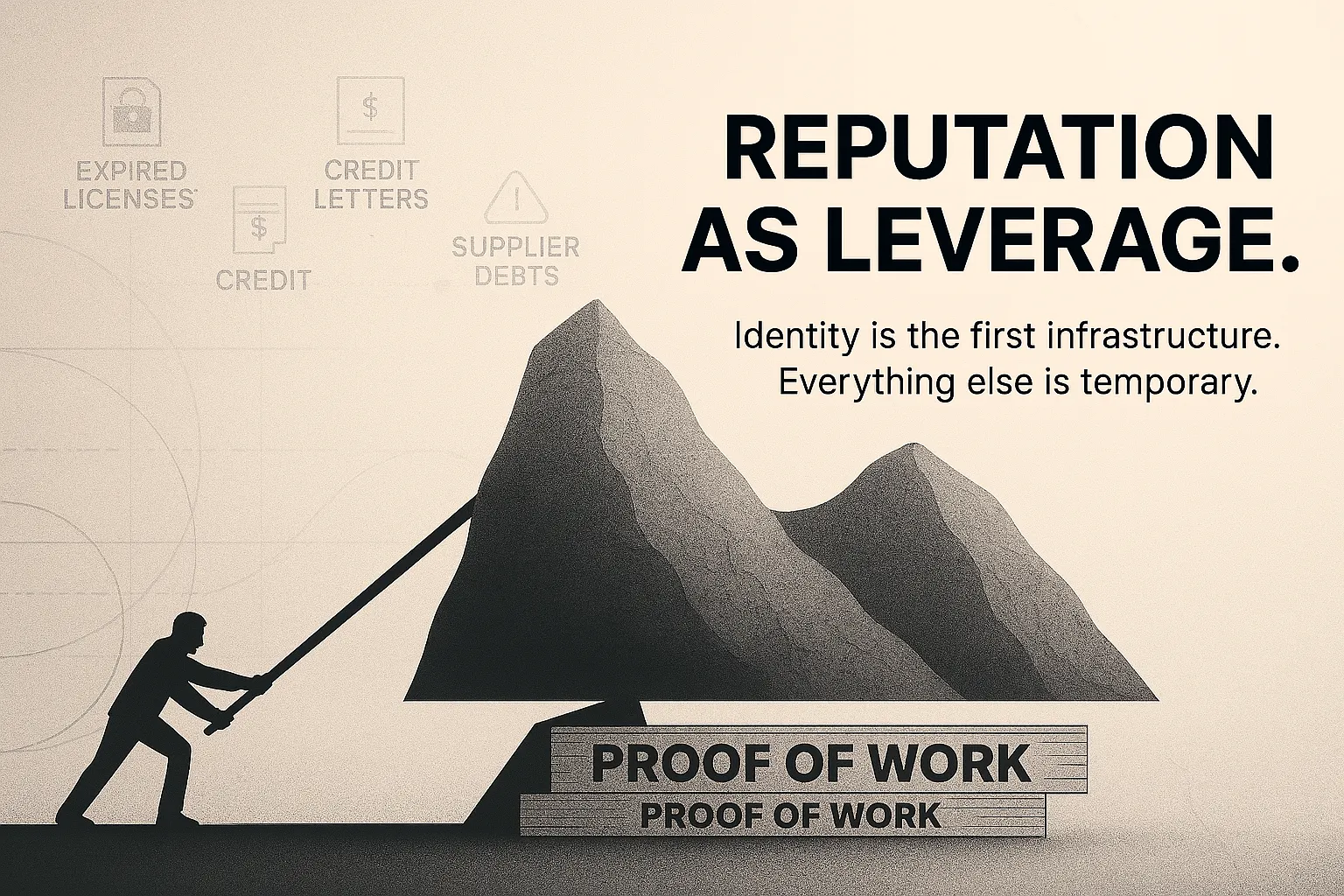
Reputation as Leverage
Reputation is one of the few assets that compounds faster than money. It grows quietly and exponentially — and once it reaches a certain threshold, it opens doors long before revenue does.
Reputation is leverage.
It is built through public behavior over time. Every decision, every interaction, every deliverable becomes part of your ledger — and in a world where everything leaves a trace, reputation becomes capital.
But here’s the part most founders never see coming:
systems still use reputation as a gatekeeping mechanism.
You can be disciplined, capable, and ready — but if your reputation inside certain institutional systems is compromised, you can be blocked before you ever get a chance to prove yourself.
This includes:
- expired licenses
- unpaid tax bills
- poor credit
- delinquent supplier payments administrative errors tied to your name
- legacy issues from past ventures
These are reputational shadows — invisible to you, but visible to the systems you’re trying to operate with.
This is why the reputation must be built intentionally.
Your behavior, consistency, and integrity become the first form of capital you ever accumulate. They become the shield that protects you from gatekeepers and the key that unlocks opportunities others never see.
A compelling reputation turns the founder into a force multiplier.
A weak reputation turns every step into friction.
The Founder as the Holding Company
Every traditional business structure has a parent company — the entity that owns the subsidiaries, the IP, the assets, and the operations. But long before a founder creates a legal holding company, they are already operating as one.
The founder is the original container.
The founder is the first infrastructure officer.
The founder is the holding company for every future venture they will ever build.
Your skills, experiences, failures, and lessons are transferable assets — and they compound across every venture you create.
A founder who has learned how to build one asset can build ten.
A founder who has survived failure can navigate volatility with clarity.
A founder who has built one system can build an ecosystem.
Everything you’ve lived becomes part of your internal portfolio.
Everything you’ve built becomes part of your internal infrastructure.
Everything you’ve overcome becomes part of your internal resilience.
This is why a strong founder's identity is more valuable than any single business. Businesses can pivot, collapse, or evolve — but the founder’s accumulated capability is still intact.
When you treat yourself as the holding company, you stop tying your identity to any one venture. You begin to see each project as an asset within a larger portfolio of your own making.
Escaping Survival Mode to Become an Asset
Survival mode is the elephant in the room — the invisible force shaping how millions think, decide, and build. It keeps you alive, but it does not help you grow. And for a Digital Asset Entrepreneur, survival mode is the single greatest threat to sovereignty.
People in survival mode cannot build assets.
They can only react.
They react to bills.
They react to crises.
They react to fear.
They react to whatever is burning the hottest.
Survival mode narrows your vision until all you can see is the next 24 hours.
Assets require you to see the next 24 months (about 2 years).
And here’s the danger:
right when your big break arrives, survival mode can sabotage it.
If your identity is still shaped by survival, your instinct will be to protect, retreat, or self-sabotage — even when opportunity is finally in front of you. The same mindset that kept you alive becomes the mindset that keeps you small.
Your will to survive becomes your demise.
This is why Digital Asset Entrepreneurs must stabilize identity before building systems. You must:
- calm the internal chaos
- create mental breathing room
- establish a personal operating rhythm
- build clarity around who you are becoming
- detach identity from circumstance
Only then can you build assets that last.
Escaping survival mode is not motivation — it is rewiring. It is shifting from reaction to authorship.
Borrowing From Your Future Self
Every founder carries two identities: the one shaped by their past, and the one shaped by their future. Most people build from the former. Digital Asset Entrepreneurs build from the latter.
Borrowing from your future self is the mindset of acting from the identity of who you’re becoming — not who you’ve been. It is the discipline of aligning your behavior with the version of you who has already built the assets, already stabilized the systems, and already earned the reputation.
This is how founders collapse over time.
When you act from your past identity, you recreate your past outcomes.
When you act from your future identity, you accelerate your future outcomes.
This is where the Kirill Avery example becomes relevant — not because of fundraising, but because of identity leverage. Avery acted from the identity of the founder he was becoming, not the 21-year-old he was at the time. That is the essence of time collapsing.
Borrowing from your future self means:
- making decisions from clarity
- building systems that match your future scale
- showing up with the discipline of the person you’re becoming
- creating assets your future self will inherit
This mindset shifts you out of reaction and into authorship. It transforms identity into momentum.
What This Means for Returning Citizens and People Rebuilding Their Lives
For returning citizens and people rebuilding their lives, this doctrine is not theoretical — it is personal. When your past has been weaponized against you, the idea that you are the first asset can feel impossible. But this is exactly why it matters.
Identity can be rebuilt.
Identity can be reauthored.
Identity can be strengthened — regardless of what came before.
Most people underestimate the power of identity because they’ve never had theirs taken from them. But returning citizens understand something the average entrepreneur never will: when your identity has been stripped or defined by someone else, rebuilding it becomes the most sovereign act you can take.
This is why the Digital Asset Entrepreneur doctrine begins with the founder. Because the founder’s transformation is the first digital asset they ever create.
When you rebuild your identity, you are constructing the internal infrastructure that every future asset will rely on. You are building:
- discipline
- clarity
- authorship
- resilience
- reputation
- proof of work
These are assets no system can confiscate. These are assets that travel with you into every room and every venture.
Your rebuild story is not a liability — it is leverage.
It proves you have already done the hardest work a founder can do: you rebuilt yourself.
You Are the First Asset You Must Build
Everything in this article leads to one truth:
you are the first asset you must build.

Before the systems, before the strategies, before the digital assets, before the audience — there is the founder. And if the founder is unstable, unclear, or still shaped by survival mode, everything built on top of them becomes fragile.
Sovereignty begins with the builder.
You are the holding company.
You are the infrastructure.
You are the reputation.
You are proof-of-work.
You are the asset that determines the value of every future asset.
When you strengthen the founder, you strengthen every venture that follows.
When you clarify the founder, you clarify every decision that follows.
When you stabilize the founder, you stabilize every system that follows.
Your identity becomes the foundation that every digital asset stands on.
And here is the sovereign truth:
no one can take the founder away from you.
You are the one asset that compounds across every season of your life.
You are the one asset that grows through adversity.
You are the one asset that becomes more valuable with every lesson, every rebuild, every iteration.
This is the doctrine:
Before you build anything else, build yourself.
Because when the founder becomes the asset, everything you create becomes inevitable.