
Morgan Stanley Opens Bitcoin to 88 Million Users and Signals an Institutional Floodgate Moment
Morgan Stanley Opens Bitcoin to 88 Million Users and Signals an Institutional Floodgate Moment
May 08, 2026
The Institutional Floodgate Moment
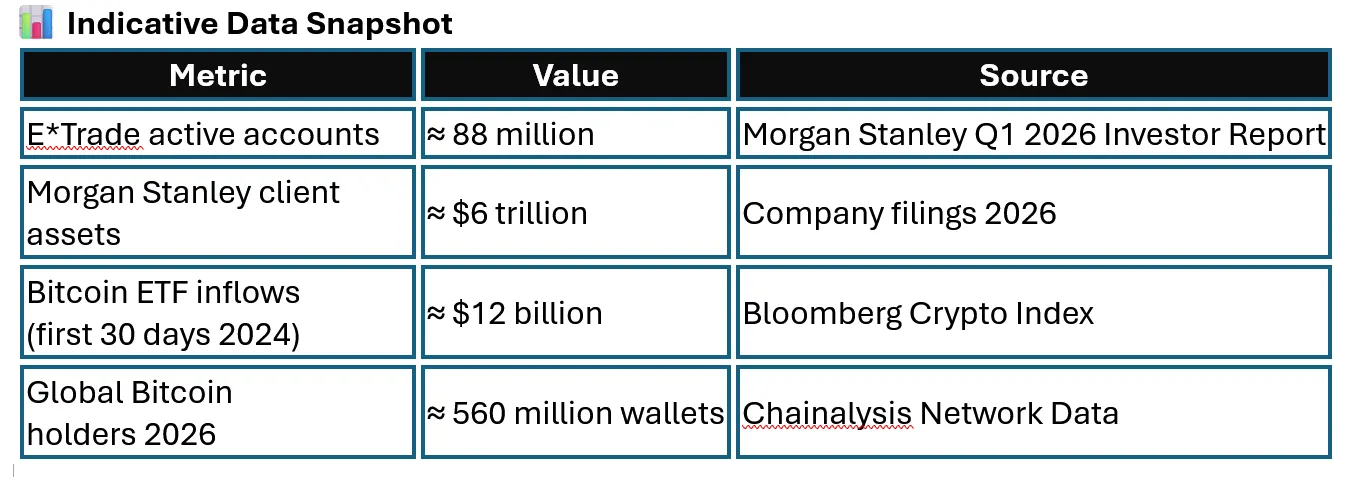
Morgan Stanley’s rollout of direct Bitcoin trading to 88 million ETrade users* is not a headline — it is a structural inflection point in global finance. For the first time, a Tier‑1 U.S. bank has embedded Bitcoin, Ether, and Solana trading directly into its retail brokerage infrastructure, transforming what was once speculative exposure into standard portfolio access.
This scale is unprecedented.
E*Trade’s user base represents nearly one‑third of all U.S. retail brokerage accounts, and Morgan Stanley’s total client assets exceed $6 trillion.
By integrating digital‑asset custody and execution internally, the firm has effectively opened a new distribution layer for Bitcoin — one that rivals the reach of the 2024 ETF inflow surge, which saw over $12 billion enter spot Bitcoin funds within the first 30 days of approval.
The implications are systemic: Bitcoin is no longer an “alternative asset.”
It is mandatory infrastructure for modern wealth management. Institutions are not merely validating the sovereign thesis — they are operationalizing it. The floodgates have opened, and the world’s largest financial intermediaries are now conduits for Bitcoin’s mainstream adoption.
What Actually Happened — The Morgan Stanley Integration
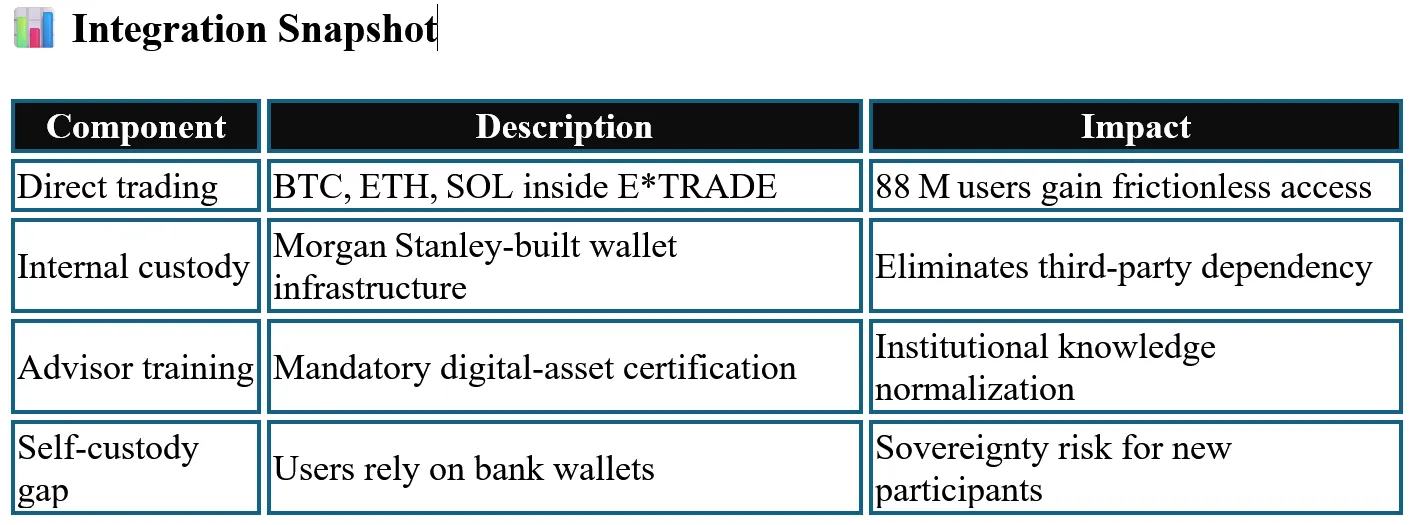
Morgan Stanley’s integration of direct Bitcoin, Ether, and Solana trading inside ETrade* represents a full‑stack transformation of brokerage architecture. This is not a superficial “crypto access” feature — it is a native digital‑asset layer embedded within the same environment where users already manage equities, ETFs, and bonds.
The bank has built its own custody and wallet infrastructure, bypassing third‑party managers and establishing internal control over private‑key storage, transaction execution, and compliance. This move positions Morgan Stanley as both custodian and exchange, a dual role that historically belonged to specialized crypto firms. Advisors across the network are now undergoing mandatory digital‑asset training, learning allocation frameworks, custody protocols, and risk‑management standards for Bitcoin exposure.
This differs fundamentally from ETF‑based exposure. ETFs provide price correlation, not ownership. Morgan Stanley’s rollout delivers direct asset custody, meaning users hold actual Bitcoin within the institution’s managed environment.
However, this institutional custody model introduces a sovereignty paradox. While millions will trust Morgan Stanley’s infrastructure — drawn by its reputation and perceived safety — true sovereignty still resides in self‑custody. The majority of new entrants will likely default to bank‑managed wallets, forfeiting control of their private keys. For Digital Asset Entrepreneurs, this moment underscores the doctrine’s core principle: custody defines ownership. Institutional adoption validates Bitcoin’s legitimacy, but self‑custody preserves freedom.
Why This Is a Historic Breakpoint for Bitcoin
Bitcoin has experienced adoption waves before — retail speculation in 2017, institutional balance‑sheet accumulation in 2020, and the ETF normalization of 2024 — but none of those moments changed the distribution layer. Morgan Stanley’s integration does. It marks the point where Bitcoin shifts from an alternative to a default allocation inside the U.S. financial system.
For the first time, Bitcoin now sits beside stocks, bonds, ETFs, and cash inside a Tier‑1 brokerage interface used by 88 million Americans. This placement alone rewires investor psychology. When an asset appears in the same environment as traditional instruments, it is no longer perceived as fringe — it becomes part of the standard portfolio construction toolkit. This is the moment Bitcoin crosses the line from “option” to obligation for advisors, analysts, and allocators.
The deeper structural shift is this: Banks are no longer gatekeepers resisting Bitcoin’s rise — they are becoming distribution engines for it.
The same institutions that once warned clients away from digital assets are now onboarding them at scale, training advisors, and embedding custody rails directly into their platforms. This is the transition from access via funds (ETF wrappers, trusts, derivatives) to access via brokerage, where users hold the underlying asset rather than a proxy.
This matters because distribution determines adoption velocity.
ETFs brought billions. Brokerages bring millions of new participants.
And once Bitcoin becomes a default option inside brokerage accounts, it becomes a default conversation inside financial planning.
The psychological impact is irreversible: When Bitcoin appears next to equities, it inherits the legitimacy of the environment. When it appears next to bonds, it becomes part of the risk‑parity discussion. When it appears next to ETFs, it becomes a portfolio weight — not a speculation.
This is the breakpoint where Bitcoin stops knocking on the door of traditional finance and simply walks in.
The 88 Million User Effect — The Distribution Layer Has Changed
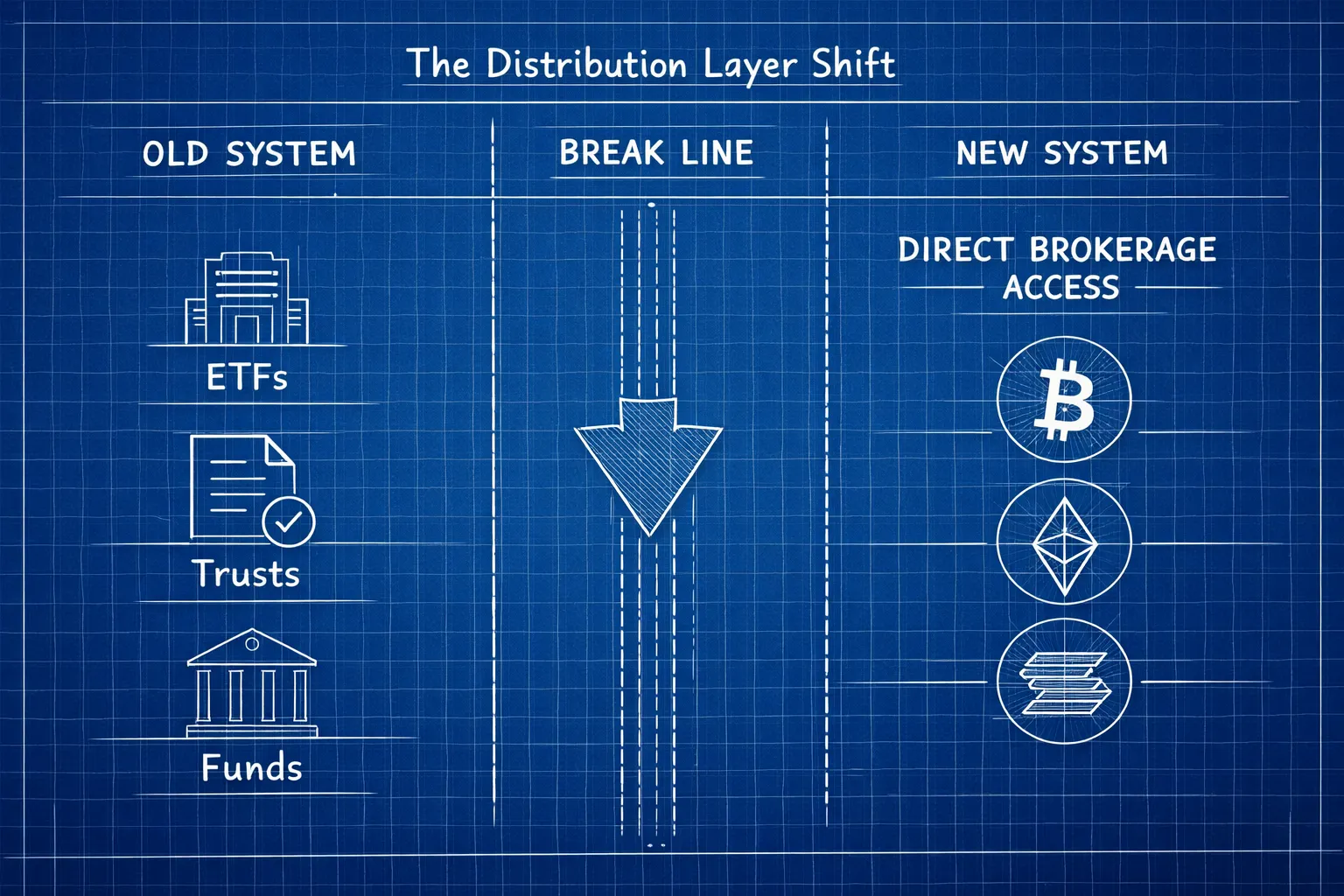
The activation of 88 million ETrade users* is not simply a large onboarding event — it is a distribution‑layer transformation. For the first time, a major U.S. brokerage has turned Bitcoin access into a frictionless default, eliminating the technical, psychological, and operational barriers that historically slowed adoption. When Bitcoin becomes a button inside an existing brokerage account, the learning curve collapses.
Millions of retail investors who would never download a wallet, manage seed phrases, or navigate an exchange now gain exposure with the same ease as buying an index fund.
This shift forces a parallel transformation inside the advisory system. Morgan Stanley’s advisors — one of the largest advisory networks in the country — must now incorporate Bitcoin into portfolio construction, risk modeling, and client planning. Once advisors are trained and required to understand Bitcoin allocation frameworks, Bitcoin becomes part of the standard financial literacy stack, not a speculative outlier. The moment an asset enters the curriculum, it enters the culture.
The compounding effect is inevitable: every brokerage will follow. Competitive pressure ensures that firms like Schwab, Fidelity, and Vanguard cannot ignore a product that 88 million investors suddenly have access to. Distribution is contagious. Once one major institution integrates Bitcoin at the brokerage layer, the rest must match the offering to retain clients.
This is how adoption accelerates:
- Bitcoin becomes a default option, not a niche pursuit.
- Advisors become distribution multipliers, not gatekeepers.
- Retail investors gain frictionless exposure, not technical hurdles.
- Brokerages become on‑ramps, not obstacles.
The 88 million user effect is not about numbers — it is about normalization at scale. Bitcoin has entered the environment where wealth is already managed, and once it lives there, it becomes part of how wealth is built.
The Sovereignty Angle — Why This Validates the Digital Asset Entrepreneur Doctrine
Bitcoin has always been more than a financial instrument — it is the base layer of personal sovereignty, the only asset that allows an individual to hold value without permission, intermediaries, or counterparty exposure. For Digital Asset Entrepreneurs (DAEs) — individuals who build systems, income streams, and long‑term autonomy around digital assets — the Morgan Stanley integration is not surprising.
It is a public confirmation of what DAEs have operated on for years: Bitcoin is foundational infrastructure, not an alternative investment.
When a Tier‑1 bank builds internal custody rails, wallet infrastructure, and advisor training programs around Bitcoin, it signals a shift from skepticism to structural acceptance. Institutions are no longer debating Bitcoin’s legitimacy — they are engineering around it. This is the moment when the doctrine becomes visible to the mainstream: the world’s largest financial entities are now validating, through architecture and distribution, what sovereign accumulators already understood.
But this validation introduces a critical divide.
Most of the 88 million new entrants will default to institutional custody, trusting Morgan Stanley to hold their Bitcoin the same way they hold equities. This is predictable — and it is precisely why sovereignty still matters.
Custody defines ownership.
If you do not control the private keys, you do not control the asset.
Institutional custody offers convenience, but it reintroduces the same risks Bitcoin was designed to eliminate: seizure, freezing, rehypothecation, and dependency.
This is why hardware self‑custody remains the highest tier of sovereignty.
It is the graduation point of the DAE identity — the moment where an individual moves from participating in the system to operating independently of it. Morgan Stanley’s adoption accelerates Bitcoin’s legitimacy, but only self‑custody preserves freedom.
What This Means for the Next 24 Months
The next 24 months will be defined by a brokerage adoption race. Morgan Stanley’s integration forces every major competitor — Schwab, Fidelity, Vanguard — into a reactive posture. Once 88 million investors gain direct Bitcoin access inside a brokerage account, every other firm must match the offering or risk client attrition. This is how distribution layers evolve: not gradually, but through competitive pressure.
As brokerages normalize access, Bitcoin allocation models will become standardized.
Advisors will begin using 1–5% allocation frameworks, risk‑parity models, and long‑term volatility‑adjusted weighting — the same tools used for equities and commodities. Once Bitcoin enters the advisory curriculum, it becomes part of the default financial literacy stack. The language of “alternative asset” disappears.
Bitcoin becomes a required conversation in wealth planning.
This shift also accelerates the next wave of digital finance:
- Stablecoins integrated into brokerage cash management
- Tokenized assets (treasuries, money markets, real estate) becoming portfolio components
- On‑chain settlement reducing counterparty risk and clearing times
- Digital identity and wallet infrastructure embedded into financial platforms
Traditional finance is not being replaced — it is being rewired onto digital rails.
But this transition creates a critical positioning moment for individuals. Just as banks are loading up infrastructure, training advisors, and preparing to enter the market at scale, you must act with equal swiftness. Institutions are preparing their systems.
You must prepare your family.
That means:
- Understanding Bitcoin not as speculation, but as sovereign infrastructure
- Building a disciplined accumulation rhythm
- Moving from custodial exposure to self‑custody
- And ultimately graduating to hardware self‑custody, the highest tier of personal financial autonomy
Institutions are positioning themselves for the next era of digital finance. Individuals must do the same — or risk being downstream from the very system Bitcoin was designed to transcend.
What Digital Asset Entrepreneurs Should Do Now
The Morgan Stanley rollout isn’t just news — it’s a signal. A positioning moment. Institutions are gearing up, building systems, and preparing to onboard millions. As a Digital Asset Entrepreneur (DAE), you can’t sit on the sidelines. You need to move with intention and get your household ready for what’s coming.
First, strengthen your accumulation systems. Don’t chase price. Don’t wait for the “perfect moment.” DAEs win through rhythm — weekly, bi‑weekly, or monthly. The habit is the edge.
Second, document your holdings and why you own them. Not for bragging. Not for performance charts. For clarity. For accountability. And so you can look back and see that you acted before the crowd showed up.
Third, build content around this moment. This is one of the biggest shifts in Bitcoin’s history. Your perspective matters. Your voice matters. DAEs don’t chase hype — they explain it, frame it, and lead through it.
Finally, prepare for the next wave of retail onboarding. Millions will enter through custodial platforms because it feels “safe.” Your job is to guide your family toward self‑custody, with hardware self‑custody as the highest level of control. Institutions are positioning themselves for the digital‑finance era. Individuals who move now won’t just participate — they’ll lead.
The Moment the System Blinked

Morgan Stanley didn’t make Bitcoin legitimate — Bitcoin forced the system to adjust. What you’re witnessing is a structural shift, not a headline. A Tier‑1 bank just opened the gates for 88 million people, and in doing so, confirmed what sovereign builders have known for years: the future is already here.
This was the moment the system blinked.
But this is where the sovereignty narrative sharpens. Institutions are moving. Advisors are training. Brokerages are racing. The financial system is repositioning itself around digital assets — fast. And yet, you are still early. You are still ahead. You are still operating with clarity while the rest of the world is just waking up.
Your job now is simple: stay disciplined, stay sovereign, and stay aligned with the future you already saw coming. This is the beginning of the floodgate era — and you’re not reacting to it. You’re positioned for it.
Movement‑Aligned
You’ve seen the shift. You understand the moment. Now it’s time to move with intention. Strengthen your systems, protect your sovereignty, and position your family for the era that’s already unfolding.