Sovereignty in the Chaos: Metals Hype, Paper Lies, and Bitcoin Proof-of-Work
Sovereignty in the Chaos: Metals Hype, Paper Lies, and Bitcoin Proof-of-Work
Mar 23, 2026
The World Is Loud Again — Perfect Timing
Gold is pumping. Silver is surging. Headlines scream about inflation, central banks, and “safe havens.” And in the middle of it all, JPMorgan gets fined for selling silver that didn’t exist.
This is what chaos looks like when it’s dressed in institutional clothing.
Retail investors rotate into metals ETFs. Hedge funds pile into silver futures. Analysts chase momentum. But none of it is sovereignty. It’s noise — loud, expensive, and fragile.
Meanwhile, Bitcoin futures are oversold. Strategy is buying more BTC. And the Sovereignty Stack is being built.
This is the moment Digital Asset Insider was designed for.
We don’t chase headlines. We decode them.
We don’t react to markets. We build systems that outlast them.
This article is not a recap. It’s a blueprint.
A breakdown of what’s real, what’s fake, and what sovereign actors do when the world panics.
Because when metals spike and paper promises collapse, the only signal worth following is proof-of-work.
Precious Metals Spike Fear, Momentum, and Misunderstanding
Gold touched $5,608. Silver broke $120.
And for a moment, the world believed metals were the answer.
But this wasn’t sovereign accumulation. It was panic dressed as positioning.
Retail investors rotated into gold ETFs. Hedge funds piled into silver futures. The Iran war, Fed subpoenas, and tariff threats triggered a flight to “safety.” But the safety was synthetic — built on paper claims and leveraged bets.
Then came the reversal.
Silver dropped 14%. Gold fell 7%.
The dollar strengthened. Oil surged. And the illusion cracked.
This is what happens when fear drives flows but not fundamentals.
Gold’s spike was fueled by central bank accumulation and fiat distrust — real signals. But the blow-off top came from momentum traders chasing headlines. Silver’s rally had industrial support — solar, EVs, and green tech, but futures positioning overwhelmed the signal.
The result? A speculative blowout followed by a tactical retracement.
And through it all, one truth remained:
Metals are valuable. But they are not sovereign.
They are mined, stored, and priced by centralized systems.
They are traded through custodians, ETFs, and futures contracts.
They are vulnerable to rehypothecation, manipulation, and paper dilution.
This is the lesson Digital Asset Insider teaches every cycle:
Price spikes are not proof. Positioning is not conviction. And volatility is not validation.
Sovereign actors don’t chase metals when they pump.
They accumulate assets that cannot be faked, diluted, or confiscated.
Which is why the next section turns to Bitcoin —
the only asset that was oversold while metals were overbought.
The JP Morgan Silver Scandal: Paper Promises vs. Real Assets
Every metals cycle has a moment when the truth slips out.
This time, it came in the form of JPMorgan being fined — again — for selling silver that wasn’t there.
Not counterfeit bars.
Not mislabeled inventory.
Paper silver. Claims without metal. Ownership without custody.
This is the quiet scandal that has defined the precious metals market for decades. The world pretends silver is scarce, yet somehow the paper market trades claims on it like confetti.
ETFs issue shares faster than vaults can verify supply.
Futures markets create leverage on top of leverage.
And custodians — the institutions everyone trusts — routinely settle trades with promises instead of ounces.
The JPMorgan fine wasn’t an anomaly.
It was a reminder.
A reminder that most people don’t own silver — they own exposure to silver.
A reminder that the metals market is built on layers of intermediaries.
A reminder that the system works until it doesn’t, and when it breaks, the customer is always the last to know.
This is why sovereignty matters.
If you don’t custody it, you don’t own it.
If you can’t audit it, you can’t trust it.
If the supply can be duplicated on paper, the price can be manipulated in practice.
The scandal didn’t shake sovereign actors.
It confirmed what they already knew:
Paper markets break. Real assets don’t.
And that brings us to the only asset that cannot be faked, duplicated, or rehypothecated — Bitcoin.
Bitcoin — Oversold While Metals Are Overbought
While gold and silver were exploding upward, something vastly different was happening beneath the surface:
Bitcoin was being quietly pushed into oversold territory — even as metals became aggressively overbought.
This isn’t opinion. It’s data.
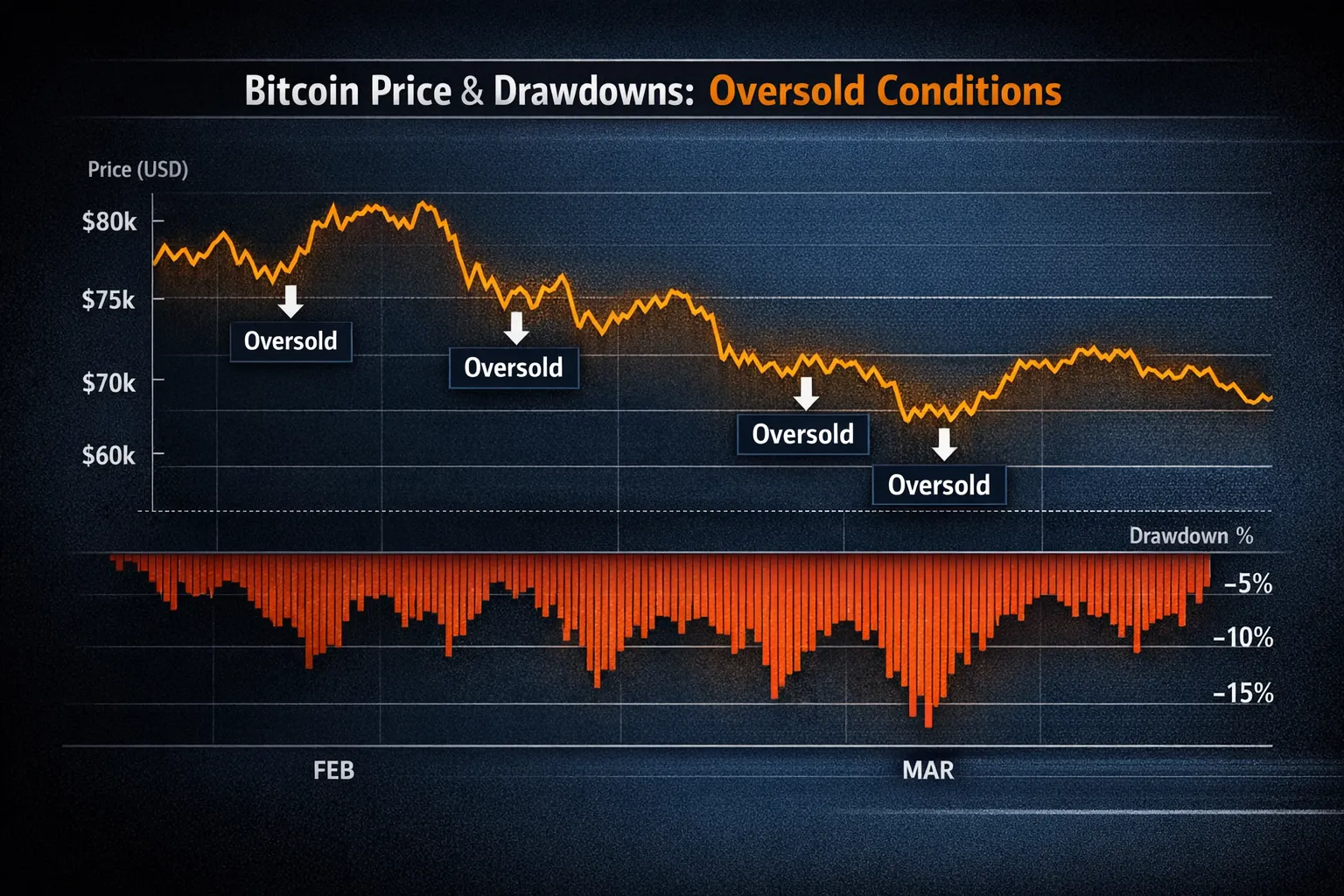
According to JPMorgan’s January 2026 market report, momentum indicators show Bitcoin futures are oversold, while gold and silver futures are overbought, driven by heavy institutional and hedge‑fund positioning in precious metals.
The divergence is stark:
- Gold ETF inflows surged to nearly $60 billion in 2025, ending the year at multi‑year highs.
- Silver ETF inflows spiked sharply in Q4 2025, coinciding with Bitcoin ETF outflows.
- Hedge funds increased long silver futures positions aggressively into early 2026.
- Bitcoin futures open interest did not rise, signaling a lack of speculative froth.
And the CME futures tape confirms the pressure:
Between Feb 23 and Mar 20, 2026, Bitcoin futures traded as low as $62,590 and as high as $76,190, with multiple sharp drawdowns — including a 4.78% drop on March 18 and a 5.24% drop on Feb 23.
This is what an oversold environment looks like:
volatility without euphoria, selling without conviction, price compression without structural weakness.
Meanwhile, metals were experiencing the opposite — momentum‑driven inflows, leveraged futures positioning, and overbought signals across every major indicator.
This divergence matters because sovereign actors don’t chase what’s crowded. They accumulate what’s mispriced.
Gold and silver were crowded.
Bitcoin was discounted.
And while retail rotated into metals, sovereign‑minded institutions — including Strategy — continued accumulating BTC with discipline, clarity, and proof‑of‑work.
Strategy’s Relentless BTC Accumulation — Proof‑of‑Work in Public
While the world was chasing metals, Strategy was doing what sovereign actors always do: accumulating Bitcoin with discipline, consistency, and zero regard for market noise.
Their behavior is not emotional. It’s engineered.
Every month, without fail, Strategy adds more BTC to its treasury.
Not because the price is up.
Not because the price is down.
But because proof‑of‑work is a system, not a reaction.
In the same period where gold spiked and silver whipsawed, Strategy executed another round of accumulation — adding more Bitcoin to a treasury that now exceeds 700,000 BTC. This is not a trade. It’s a sovereign strategy.
And the market sees it.
Every purchase is a public signal:
- We are not speculating.
- We are not timing.
- We are building a Bitcoin‑backed institution.
This is the opposite of the metals frenzy.
Gold and silver pumped because traders chased momentum.
Bitcoin dipped because futures positioning turned oversold.
Strategy bought because their system told them to buy.
That’s the difference between noise and sovereignty.
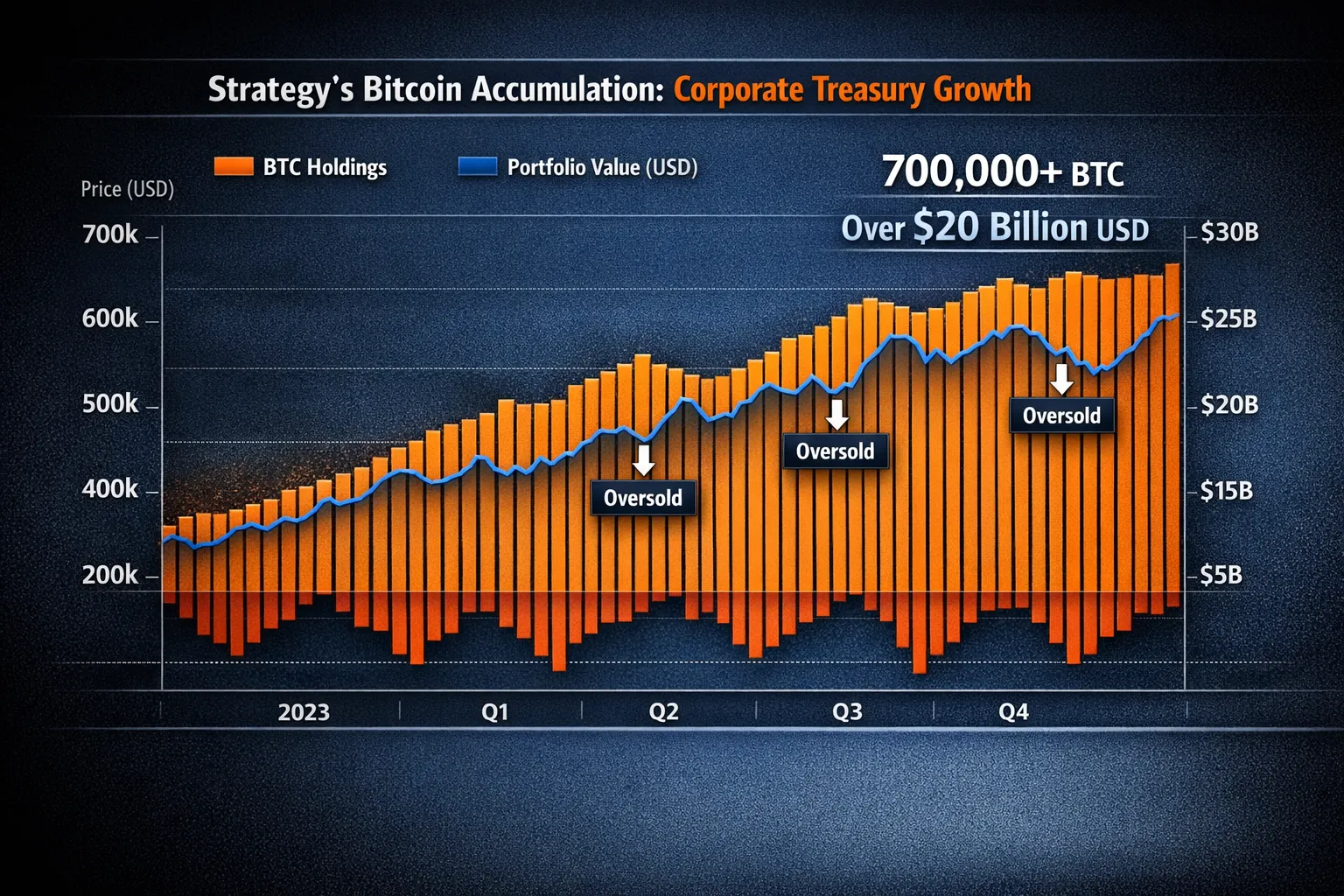
Strategy’s treasury behavior models what Digital Asset Insider teaches:
- Build a system.
- Follow the system.
- Let the system outlast the chaos.
Their monthly BTC accumulation is the purest form of corporate proof‑of‑work in the modern financial world.
It’s transparent.
It’s repeatable.
It’s sovereign.
And it reinforces the core message of this article:
When the world panics, sovereign actors build.
The Sovereignty Stack — Built for Moments Like This
Every chaotic cycle reveals the same truth:
Most people don’t have a system.
They have reactions.
They have emotions.
They have headlines.
But they don’t have sovereignty.
That’s why the Sovereignty Stack exists.
It’s not a product. It’s not a course. It’s not a collection of tips. It’s a framework for surviving a world that keeps proving it cannot be trusted.
Look at the last few weeks:
Gold and silver pumped because traders chased fear.
JP Morgan was fined for selling silver that didn’t exist.
Bitcoin was oversold because futures markets mispriced it.
Strategy kept buying because their system told them to buy.
This is the exact environment the Sovereignty Stack was built for.
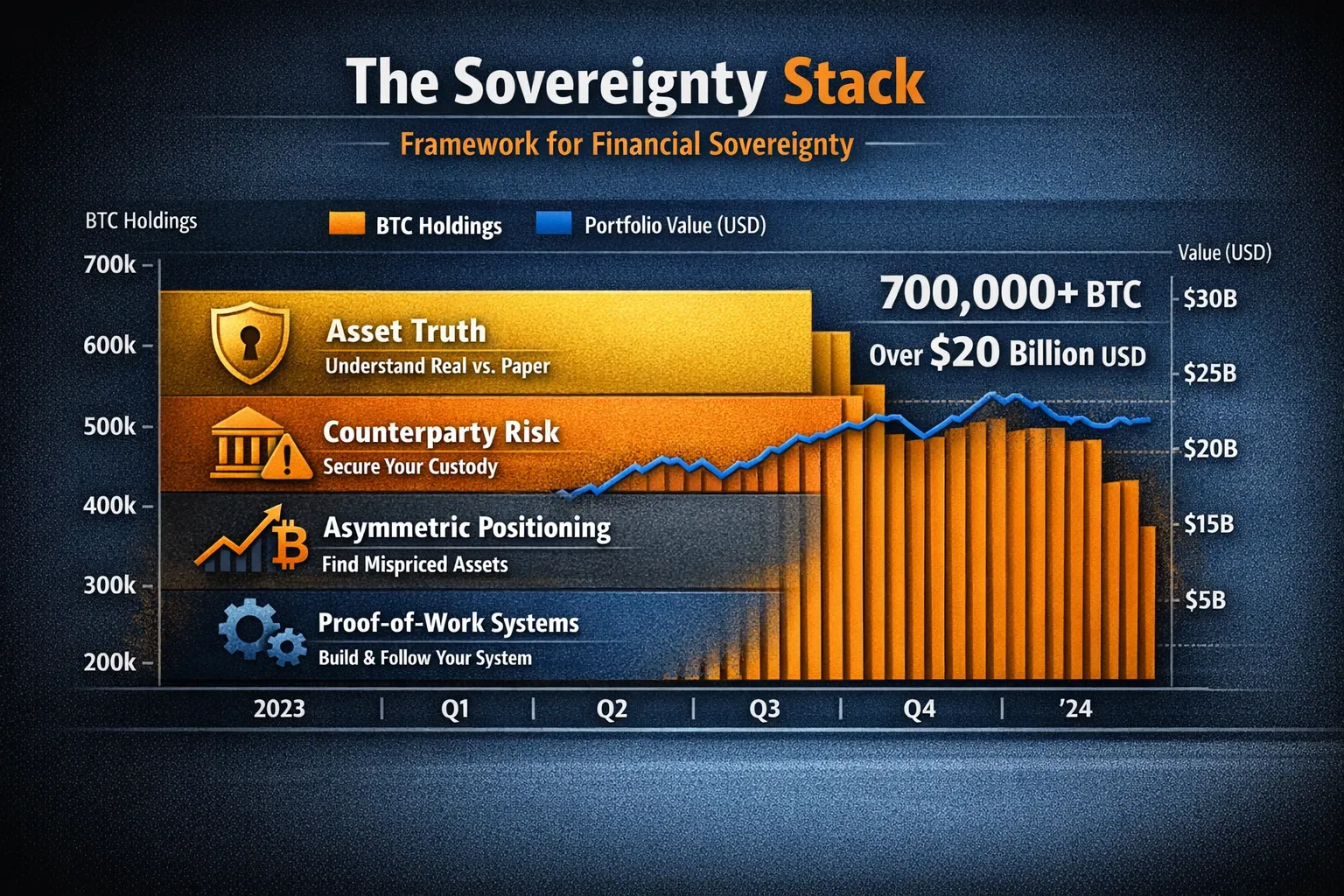
Layer 1: Asset Truth
You learn the difference between owning an asset and owning exposure to an asset. Metals taught that lesson the hard way.
Layer 2: Counterparty Risk
You learn why custody is sovereignty. JP Morgan taught that lesson for you.
Layer 3: Asymmetric Positioning
You learn how to identify mispriced opportunities. Bitcoin taught that lesson while metals were overheating.
Layer 4: Proof‑of‑Work Systems
You learn how to build a system that removes emotion from your decisions. Strategy models that lesson every month.
The Sovereignty Stack is not about predicting markets.
It’s about outlasting them.
It gives you a structure that doesn’t bend when the world panics.
A doctrine that doesn’t change when headlines shift. A blueprint that keeps you sovereign when everyone else is reactive.
Because sovereignty isn’t a feeling.
It’s a system.
And systems only matter when the world is loud, confused, and chasing the wrong signals.
Which brings us to the final section — what all of this means for the Digital Asset Entrepreneur.
What This Means for the Digital Asset Entrepreneur
For the Digital Asset Entrepreneur, the last few weeks weren’t just market events — they were a live‑fire demonstration of why sovereignty matters.
Most people reacted.
Sovereign actors observed.
DAEs interpreted.
Gold pumped, silver spiked, and paper markets cracked.
Bitcoin dipped, headlines panicked, and liquidity rotated.
But none of that changed the mission.
Because the Digital Asset Entrepreneur isn’t a trader.
You’re a builder.
A system‑designer.
A sovereign operator in a world addicted to noise.
The metals frenzy showed how quickly crowds chase momentum.
The JP Morgan scandal showed how fragile custodial trust really is.
Bitcoin’s oversold positioning showed where the real asymmetry lives.
Strategy’s accumulation showed what disciplined execution looks like.
This is the blueprint for the DAE:
- You don’t chase markets — you study them.
- You don’t react to volatility — you leverage it.
- You don’t follow headlines — you follow systems.
- You don’t outsource sovereignty — you build it.
Every cycle reinforces the same truth:
The world rewards noise, but wealth rewards discipline.
And the Digital Asset Entrepreneur is the only archetype built for both.
This moment wasn’t a distraction.
It was a reminder — that sovereignty is earned, not inherited, and that the DAE path is the only path that turns chaos into opportunity.
The Calm in the Chaos
The world will always find new ways to panic.
New headlines. New scandals. New “safe havens.”
But sovereignty isn’t built in the noise — it’s built in the silence that follows.
Gold will spike. Silver will crash. Paper markets will break.
Bitcoin will be mispriced, misunderstood, and underestimated.
And institutions will continue revealing exactly who they are.
But the sovereign actor moves differently.
You don’t chase the frenzy.
You don’t react to the chaos.
You don’t outsource your judgment to markets that can be manipulated, diluted, or faked.
You build systems.
You follow proof‑of‑work.
You stay grounded while the world shakes itself apart.

This is the calm in the chaos — the place where Digital Asset Entrepreneurs operate. Not as spectators.
Not as traders.
But as sovereign builders in a world that keeps proving why sovereignty matters.
The noise will rise again.
It always does.
But now you have the doctrine, the framework, and the stack to stay unmoved.
Because sovereignty isn’t a reaction. It’s a system.